TITAF-P-7875172: Difference between revisions
No edit summary |
No edit summary |
||
| (12 intermediate revisions by the same user not shown) | |||
| Line 1: | Line 1: | ||
<div style="text-align:right;"> | |||
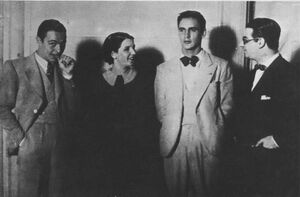
<small>Image shows Malerba, Libertad Lamarque, Daniel Álvarez and Antonio Rodio in 1935</small> | |||
</div> | |||
{{Person | {{Person | ||
|PersonName=Antonio Rodio | |PersonName=Antonio Rodio | ||
| Line 10: | Line 13: | ||
|Occupation=violinist;;conductor;;composer | |Occupation=violinist;;conductor;;composer | ||
|instrument=violin | |instrument=violin | ||
|Commons image URL short=Malerba-Libertad_Lamarque-D_Alvarez-Antonio_Rodio-1935.jpg | |||
|wikidataID=Q24567753 | |wikidataID=Q24567753 | ||
|Todotango_links=https://www.todotango.com/creadores/ficha/29/Antonio-Rodio | |Todotango_links=https://www.todotango.com/creadores/ficha/29/Antonio-Rodio | ||
|PersonFreeText=Antonio Rodio | |PersonFreeText== Antonio Rodio = | ||
'''Antonio Rodio''' (Crispiano, Italy, 25 January 1904 – Viña del Mar, Chile, 1 June 1980) was a refined violinist, composer, arranger, and orchestra leader who contributed significantly to the evolutionist strand of tango. His tone was elegant, his phrasing expressive, and his artistic choices consistently marked by taste and integrity. | |||
== Early Life and Education == | |||
Born in Crispiano, province of Taranto, Rodio emigrated to Argentina as a child with his parents [[Roque Rodio]] and [[Francesca Pumarola]] and six siblings. The family settled in Parque Patricios, Buenos Aires. He attended primary school on Deán Funes Street and began his musical training under [[Mario Rossner]]. By 1912, he completed his initial violin studies and advanced to the Thibaud-Piazzini Conservatory, graduating as a concert soloist. He later received his professor’s diploma from the Rossengger Conservatory in 1918. | |||
== Early Career == | |||
At just 11, Rodio replaced [[Carlos Pessina]] in the Cine Empire orchestra and later joined the Teatro Colón's classical ensemble, where he became concertmaster. In the early 1920s, he transitioned into tango, performing with [[Ángel Danesi]]'s orchestra and forming a quartet with [[TITAF-P-5096506|Carlos Marcucci]]. He collaborated with figures such as [[TITAF-P-6714838|Osvaldo Fresedo]], [[TITAF-P-3168998|Domingo Santa Cruz]], and [[TITAF-P-4698351|Alfonso Lacueva]], and took part in early tango radio broadcasts. | |||
== Collaborations and Studio Work == | |||
In 1929, Rodio recorded duets with [[TITAF-P-2065521|Enrique Delfino]] for Odeon and replaced [[TITAF-P-2596542|Elvino Vardaro]] in [[Orquesta Típica Pedro Maffia]]. On 19 April 1930, he recorded with [[TITAF-T-0012255|Carlos Gardel]], accompanied by [[TITAF-P-6058791|Rodolfo Biagi]] on piano, contributing to classics like ''Buenos Aires'', ''Viejo smoking'', and the foxtrot ''Yo nací para ti, tú serás para mí''. | |||
He later joined the [[Irusta-Fugazot-Demare]] trio with [[TITAF-P-3059129|Agustín Irusta]], [[TITAF-P-4900435|Roberto Fugazot]], and [[TITAF-P-1737214|Lucio Demare]], and alongside [[TITAF-P-2065521|Enrique Delfino]] and [[TITAF-P-8523261|Manuel Parada]], backed prominent vocalists including [[TITAF-P-7395900|Sofía Bozán]], [[TITAF-P-9206082|Ada Falcón]], [[TITAF-P-6511889|Agustín Magaldi]], and [[TITAF-P-1746380|Azucena Maizani]]. | |||
== Los Poetas del Tango and Beyond == | |||
In 1936, Rodio founded ''[[Los Poetas del Tango]]'' with [[TITAF-P-9906219|Francisco Fiorentino]], [[TITAF-P-7906001|Héctor María Artola]], [[TITAF-P-2506951|Miguel Bonano]], and pianist [[TITAF-P-1262201|Miguel Nijensohn]], performing on Radio Belgrano. After its dissolution, he joined [[TITAF-P-2845849|Eduardo Ferri]]’s orchestra and performed in ensembles with [[TITAF-P-5536740|Enrique Rodríguez]] and [[TITAF-P-5678593|Gabriel Clausi]]. | |||
Style | == Own Orchestra and Style == | ||
In 1941, Rodio formed his own orchestra, enlisting talents like [[TITAF-P-5140894|Héctor Stamponi]], [[TITAF-P-6788580|Carlos Parodi]], [[TITAF-P-3066753|Antonio Ríos]], [[TITAF-P-4653851|Ernesto Rossi]], [[TITAF-T-0012812|Mario Demarco]], [[TITAF-P-3671378|Eduardo Rovira]], [[TITAF-P-5870620|Luis Bonnat]], [[TITAF-P-9977716|Tomás Cervo]], [[TITAF-P-7716909|Juan José Fantín]], [[TITAF-P-3522300|Máximo Mori]], [[TITAF-P-6331941|Jaime Gosis]], and vocalists [[TITAF-P-9320407|Alberto Serna]], [[TITAF-P-9282852|Mario Corrales]], and [[TITAF-P-6082300|Antonio Rodríguez Lesende]]. The group debuted on Radio Splendid, appeared in venues such as Café El Nacional and Café Germinal, and quickly gained popularity. Between 1943 and 1944, they recorded sixteen tracks for Odeon, noted for their melodic richness and refined arrangements. | |||
== Final Years and Life in Chile == | |||
Rodio toured the Americas with [[TITAF-P-2177034|Miguel Caló]] in 1945 and decided to settle in Chile in 1946. He briefly returned to Buenos Aires to work with [[Orquesta de Francisco Rotundo]] but settled permanently in Viña del Mar in 1949 after another tour with [[Orquesta de Gabriel Clausi]] (which included [[TITAF-P-1303722|Astor Piazzolla]], [[TITAF-P-1000773|Antonio Rossi]], [[TITAF-P-1628005|Luis Piersantelli]], and [[TITAF-P-4856918|Leopoldo Amoroso]]). | |||
In Chile, Rodio formed international music groups, directed at the Casino Municipal de Viña del Mar, co-founded the [[Orquesta Sinfónica de Viña del Mar]] (1954–1956), and played with [[Orquesta de Cámara de la Universidad de Chile]] and [[Orquesta de Cámara de la Universidad Católica de Viña del Mar]]. He served as first violin in the [[Orquesta Estable del Festival de la Canción de Viña del Mar]] and briefly led a tango group performing in local venues. | |||
Rodio | |||
== Vocalists == | |||
Singers who worked with Rodio included: [[TITAF-P-9906219|Francisco Fiorentino]], [[TITAF-P-9282852|Mario Corrales]], [[TITAF-P-6082300|Antonio Rodríguez Lesende]], [[TITAF-P-3789225|Alberto Amor]], [[TITAF-P-6371342|Carlos Varela]], [[Daniel Adorno]], and [[TITAF-P-9320407|Alberto Serna]]. | |||
Many of his most poignant lyrics were co-written with [[TITAF-P-6829643|José María Contursi]]. | |||
== Legacy == | |||
Rodio was a key figure in the stylistic evolution of tango. Though less remembered due to his departure from Argentina at the height of his career, his recordings, arrangements, and violin artistry remain exemplary. His tone, phrasing, and compositional sensitivity earned him deep respect among peers. | |||
Diagnosed with throat cancer in early 1980, he died of heart failure on 1 June 1980 in Viña del Mar. | |||
== Sources == | |||
* [https://www.todotango.com/creadores/biografia/47/Antonio-Rodio/ Todotango.com – “Antonio Rodio”] (original text published in ''Revista Tango y Lunfardo'', Nº 66, Chivilcoy, 23 April 1991) | |||
* [https://es.wikipedia.org/wiki/Antonio_Rodio Spanish-language Wikipedia article on Antonio Rodio] | |||
* [https://tangosalbardo.blogspot.com/2013/02/antonio-rodio.html TangoSalbardo.blogspot.com – “Antonio Rodio” (February 2013)] | |||
|instanceOf=human | |instanceOf=human | ||
}} | }} | ||
[[Category:TangoPeople]] | [[Category:TangoPeople]] | ||
<noinclude>{{DISPLAYTITLE:Antonio Rodio}}</noinclude> | <noinclude>{{DISPLAYTITLE:Antonio Rodio}}</noinclude> | ||
Latest revision as of 10:52, 24 May 2025
Image shows Malerba, Libertad Lamarque, Daniel Álvarez and Antonio Rodio in 1935

Real name Antonio Rodio
Life 25 January 1904 – 1 June 1980
Occupation
-
• violinist
• conductor
• composer
Instrument
-
• violin
Place of birth Crispiano, Tarento
Country of birth Italy
Citizenship
-
• Italy
• Kingdom of Italy
TodoTango: Link
Antonio Rodio
Antonio Rodio (Crispiano, Italy, 25 January 1904 – Viña del Mar, Chile, 1 June 1980) was a refined violinist, composer, arranger, and orchestra leader who contributed significantly to the evolutionist strand of tango. His tone was elegant, his phrasing expressive, and his artistic choices consistently marked by taste and integrity.
Early Life and Education
Born in Crispiano, province of Taranto, Rodio emigrated to Argentina as a child with his parents Roque Rodio and Francesca Pumarola and six siblings. The family settled in Parque Patricios, Buenos Aires. He attended primary school on Deán Funes Street and began his musical training under Mario Rossner. By 1912, he completed his initial violin studies and advanced to the Thibaud-Piazzini Conservatory, graduating as a concert soloist. He later received his professor’s diploma from the Rossengger Conservatory in 1918.
Early Career
At just 11, Rodio replaced Carlos Pessina in the Cine Empire orchestra and later joined the Teatro Colón's classical ensemble, where he became concertmaster. In the early 1920s, he transitioned into tango, performing with Ángel Danesi's orchestra and forming a quartet with Carlos Marcucci. He collaborated with figures such as Osvaldo Fresedo, Domingo Santa Cruz, and Alfonso Lacueva, and took part in early tango radio broadcasts.
Collaborations and Studio Work
In 1929, Rodio recorded duets with Enrique Delfino for Odeon and replaced Elvino Vardaro in Orquesta Típica Pedro Maffia. On 19 April 1930, he recorded with Carlos Gardel, accompanied by Rodolfo Biagi on piano, contributing to classics like Buenos Aires, Viejo smoking, and the foxtrot Yo nací para ti, tú serás para mí.
He later joined the Irusta-Fugazot-Demare trio with Agustín Irusta, Roberto Fugazot, and Lucio Demare, and alongside Enrique Delfino and Manuel Parada, backed prominent vocalists including Sofía Bozán, Ada Falcón, Agustín Magaldi, and Azucena Maizani.
Los Poetas del Tango and Beyond
In 1936, Rodio founded Los Poetas del Tango with Francisco Fiorentino, Héctor María Artola, Miguel Bonano, and pianist Miguel Nijensohn, performing on Radio Belgrano. After its dissolution, he joined Eduardo Ferri’s orchestra and performed in ensembles with Enrique Rodríguez and Gabriel Clausi.
Own Orchestra and Style
In 1941, Rodio formed his own orchestra, enlisting talents like Héctor Stamponi, Carlos Parodi, Antonio Ríos, Ernesto Rossi, Mario Demarco, Eduardo Rovira, Luis Bonnat, Tomás Cervo, Juan José Fantín, Máximo Mori, Jaime Gosis, and vocalists Alberto Serna, Mario Corrales, and Antonio Rodríguez Lesende. The group debuted on Radio Splendid, appeared in venues such as Café El Nacional and Café Germinal, and quickly gained popularity. Between 1943 and 1944, they recorded sixteen tracks for Odeon, noted for their melodic richness and refined arrangements.
Final Years and Life in Chile
Rodio toured the Americas with Miguel Caló in 1945 and decided to settle in Chile in 1946. He briefly returned to Buenos Aires to work with Orquesta de Francisco Rotundo but settled permanently in Viña del Mar in 1949 after another tour with Orquesta de Gabriel Clausi (which included Astor Piazzolla, Antonio Rossi, Luis Piersantelli, and Leopoldo Amoroso).
In Chile, Rodio formed international music groups, directed at the Casino Municipal de Viña del Mar, co-founded the Orquesta Sinfónica de Viña del Mar (1954–1956), and played with Orquesta de Cámara de la Universidad de Chile and Orquesta de Cámara de la Universidad Católica de Viña del Mar. He served as first violin in the Orquesta Estable del Festival de la Canción de Viña del Mar and briefly led a tango group performing in local venues.
Vocalists
Singers who worked with Rodio included: Francisco Fiorentino, Mario Corrales, Antonio Rodríguez Lesende, Alberto Amor, Carlos Varela, Daniel Adorno, and Alberto Serna.
Many of his most poignant lyrics were co-written with José María Contursi.
Legacy
Rodio was a key figure in the stylistic evolution of tango. Though less remembered due to his departure from Argentina at the height of his career, his recordings, arrangements, and violin artistry remain exemplary. His tone, phrasing, and compositional sensitivity earned him deep respect among peers.
Diagnosed with throat cancer in early 1980, he died of heart failure on 1 June 1980 in Viña del Mar.
Sources
- Todotango.com – “Antonio Rodio” (original text published in Revista Tango y Lunfardo, Nº 66, Chivilcoy, 23 April 1991)
- Spanish-language Wikipedia article on Antonio Rodio
- TangoSalbardo.blogspot.com – “Antonio Rodio” (February 2013)
Orchestras
No known group memberships.
Recordings
No recordings found.