TITAF-P-1002362: Difference between revisions
No edit summary |
No edit summary |
||
| Line 10: | Line 10: | ||
|Commons image URL short=Francisco-Paredes-Herrera_.jpg | |Commons image URL short=Francisco-Paredes-Herrera_.jpg | ||
|wikidataID=Q105687527 | |wikidataID=Q105687527 | ||
|PersonFreeText=''' | |PersonFreeText='''Francisco Paredes Herrera''' (born 8 November 1891 in [[Cuenca]], died 1 January 1952 in [[Guayaquil]]) was a notable Ecuadorian composer. He was the son of [[Francisco Paredes Orellana]] and [[Virginia Herrera]]. | ||
== Early Life and Education == | |||
== Career in Guayaquil == | == Early Life and Education ==
| ||
Paredes Herrera completed all his studies in his hometown of [[Cuenca]]. At the age of ten, his father—himself a musician—introduced him to José Basso, an Italian priest, who taught him composition and harmony. | |||
== Career in Guayaquil ==
| |||
Since 1920, Paredes Herrera lived permanently in [[Guayaquil]], where he soon became a widely known composer, especially for national rhythms and musical forms. He composed pasodobles, pasacalles, boleros, sanjuanitos, yaravíes, danzantes, and most notably, pasillos of exceptional beauty. For this, he earned the title "El Rey del Pasillo Ecuatoriano" (The King of the Ecuadorian Pasillo). | |||
He set to music the verses of prominent poets, both Ecuadorian and foreign, including [[Elías Cedeño Jervis]], [[Manuel Coello]], [[Medardo Ángel Silva]], [[Julio Flores]], [[Jorge Ismael Gandú]], [[Aurelio Martínez]], [[Libardo Parra]], and [[TITAF-P-7223761|Juan de Dios Peza]]. | He set to music the verses of prominent poets, both Ecuadorian and foreign, including [[Elías Cedeño Jervis]], [[Manuel Coello]], [[Medardo Ángel Silva]], [[Julio Flores]], [[Jorge Ismael Gandú]], [[Aurelio Martínez]], [[Libardo Parra]], and [[TITAF-P-7223761|Juan de Dios Peza]]. | ||
== Notable Works == | |||
== Notable Works ==
| |||
Some of his most beautiful pasillos include: | |||
* [[El alma en los labios]] | * [[El alma en los labios]] | ||
* [[TITAF-T-0023206|Horas de pasión]] | * [[TITAF-T-0023206|Horas de pasión]] | ||
| Line 23: | Line 30: | ||
* [[Como si fuera un niño]] | * [[Como si fuera un niño]] | ||
* [[TITAF-T-0023194|Tú y yo]] – This song earned the [[Hermanos Miño Naranjo]] first prize at the Second Ibero-American Song Fair held in [[Barcelona]] in 1964. | * [[TITAF-T-0023194|Tú y yo]] – This song earned the [[Hermanos Miño Naranjo]] first prize at the Second Ibero-American Song Fair held in [[Barcelona]] in 1964. | ||
== Death == | |||
== Death ==
| |||
Sadly, Francisco Paredes Herrera passed away on 1 January 1952, before witnessing the international success of his composition "[[TITAF-T-0023194|Tú y yo]]". He died surrounded by the admiration and affection of the Ecuadorian people. | |||
|instanceOf=human | |instanceOf=human | ||
}} | }} | ||
[[Category:TangoPeople]]<noinclude>{{DISPLAYTITLE:Francisco Paredes Herrera}}</noinclude> | [[Category:TangoPeople]]<noinclude>{{DISPLAYTITLE:Francisco Paredes Herrera}}</noinclude> | ||
Revision as of 19:05, 22 June 2025
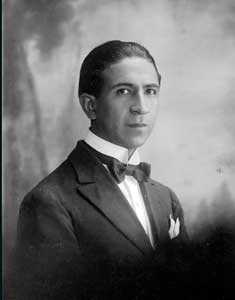

Life 8 November 1891 – 1952
Occupation
-
• composer
Place of birth Cuenca
Country of birth Ecuador
Citizenship
-
• Ecuador
Francisco Paredes Herrera (born 8 November 1891 in Cuenca, died 1 January 1952 in Guayaquil) was a notable Ecuadorian composer. He was the son of Francisco Paredes Orellana and Virginia Herrera.
== Early Life and Education == Paredes Herrera completed all his studies in his hometown of Cuenca. At the age of ten, his father—himself a musician—introduced him to José Basso, an Italian priest, who taught him composition and harmony.
== Career in Guayaquil == Since 1920, Paredes Herrera lived permanently in Guayaquil, where he soon became a widely known composer, especially for national rhythms and musical forms. He composed pasodobles, pasacalles, boleros, sanjuanitos, yaravíes, danzantes, and most notably, pasillos of exceptional beauty. For this, he earned the title "El Rey del Pasillo Ecuatoriano" (The King of the Ecuadorian Pasillo).
He set to music the verses of prominent poets, both Ecuadorian and foreign, including Elías Cedeño Jervis, Manuel Coello, Medardo Ángel Silva, Julio Flores, Jorge Ismael Gandú, Aurelio Martínez, Libardo Parra, and Juan de Dios Peza.
== Notable Works == Some of his most beautiful pasillos include:
- El alma en los labios
- Horas de pasión
- Manabí
- Rosario de besos
- El último pasillo
- Unamos los corazones
- Como si fuera un niño
- Tú y yo – This song earned the Hermanos Miño Naranjo first prize at the Second Ibero-American Song Fair held in Barcelona in 1964.
== Death == Sadly, Francisco Paredes Herrera passed away on 1 January 1952, before witnessing the international success of his composition "Tú y yo". He died surrounded by the admiration and affection of the Ecuadorian people.
Orchestras
No known group memberships.
Recordings
No recordings found.
Opus
| Title | Genre | Alt. title | Comp. Year |
|---|---|---|---|
| Por mi morena | Pasodoble |