Rafael Rossi
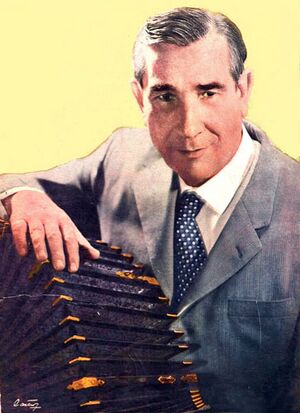

Real name Rafael Rossa
Life 28 December 1896 – 24 December 1982
Occupation
-
• bandoneonist
• composer
• director.
Instrument
-
• bandoneon
Place of birth Mercedes, Buenos Aires
Country of birth Argentina
Citizenship
-
• Argentina
TodoTango: Link
Rafael Rossi (Mercedes, Buenos Aires Province, 28 December 1896 – Buenos Aires, 24 December 1982) was an Argentine bandoneonist, composer, arranger, and orchestra leader. Known for his versatility, his long career bridged the worlds of tango and Argentine folk music. He was a prolific touring artist, a dedicated performer, and a close associate of Carlos Gardel.
Early Life and Beginnings
Born in Mercedes, Rossi was captivated by the sound of the bandoneon from a young age. In 1912, he moved to Buenos Aires, initially working as a painter. Inspired by live performances and musicians he encountered, he began studying bandoneon at the academy of Don José De Caro, father of Julio De Caro, Francisco De Caro, and Emilio De Caro. The outbreak of World War I disrupted his studies, and he returned to the provinces.
He embarked on adventurous tours across rural Argentina, performing in small towns with guitarist Pedro Laffourcade and later with other collaborators such as Roque Del Cagneo and Timoteo Palacios. These travels took him through Junín, Rufino, Huinca Renancó, Río Cuarto, and many other towns, often under difficult conditions. His first formal ensemble experience came in Vedia, and from then on, he continued to tour constantly.
Entry into Tango Circles
By 1919, Rossi had returned to Buenos Aires and connected with pianist José Martínez. In 1920, he played in a large orchestra formed by Roberto Firpo and Francisco Canaro for carnival celebrations. That same year, he met Carlos Gardel, forming a friendship that would last for decades. From 1920 to 1935, Rossi maintained a close professional link with Canaro, participating in numerous performances and tours, including a contract in Tucumán.
Orchestra Leader and Composer
Rossi formed his own tango orchestra and performed in Buenos Aires cafés, including Café Los Andes, often working alongside the De Caro brothers. In 1924, he played with Roberto Firpo’s orchestra during the first tango contest organized by Max Glücksmann at the Cine Grand Splendid.
As the film industry adopted sound, diminishing the demand for live musicians in cinemas, Rossi adapted by forming a folk-oriented ensemble. He began recording Argentine folk music with the Discos Nacional label in 1928. Although his true passion remained with tango, exclusive recording contracts forced him to specialize in folkloric genres on disc. His live performances, however, continued to include tango.
His preferred vocalists included the Casadei brothers and Herminia Velich. Rossi maintained a steady presence in the recording industry for over fifty years, including long stints with the Odeon label.
Collaboration with Carlos Gardel
Carlos Gardel was one of the musicians most closely associated with Rossi. Their friendship began at the Glücksmann recording house, where Rossi was working with Firpo and Gardel was recording with José Razzano. Gardel recorded many of Rossi’s works, beginning with the zamba “Cañaveral” in 1925, followed by a wide range of tangos, valses, milongas, rancheras, and styles.
Notably, Gardel once declined to record Rossi’s tango “Renacimiento” because it had no lyrics; on another occasion, he requested the vals “Rosa de abril” and commissioned Eugenio Cárdenas to write lyrics for it. Their musical partnership reflected deep mutual respect and personal trust.
Compositions
Rossi’s first composition was “Don Leandro” in 1915. His creative output includes numerous tangos, folk songs, and other popular genres. Among his most notable compositions are:
Tangos and Songs
- Jueves (with Udelino Toranzo)
- Pacho
- Se fue y no volvió
- El paisano
- Mi pebeta
- Viernes 13
- Ojerosa
- Tu cariño
- Renacimiento
- El zaino
- Polichinela
- Don Pancho Fierro
- El alma del arrabal
- Callejón y huella
- La veterana
- El conventillo
- Vida perra
- Buena pilcha
- El calavera no grita
- Cuando tallan los recuerdos
- Bendita sea
- Ponete paquete
- A vos te dicen Don Juan
- La pena de muerte
Recorded by Gardel
- Cañaveral (zamba)
- Por el llano
- Ave cantora
- La milonga
- Perdonada
- Sos de Chiclana
- Fiesta criolla
- Senda florida
- Ebrio (with José Rial)
- Contramarca
- Primero yo (with José Rial)
- Corazoncito (with José Rial)
- Pa'l cambalache
- Como abrazado a un rencor (with Antonio Podestá)
- Como las margaritas
- Rosa de abril (with Eugenio Cárdenas)
- La pastelera
Valses
- Al pie de tu reja
- Al caer la tarde
- Tus labios (with Guillermo Barbieri and Eugenio Cárdenas)
- En tu florido balcón
- Si la ven por estos pagos
- Lamento criollo
His lyric collaborators included José Rial, Francisco Brancatti, Hermanos Navarrine, Antonio Podestá, María Luisa Carnelli, Pedro Numa Córdoba, Francisco Gorrindo, Mariano de la Torre, Enrique Cadícamo, and Lito Bayardo.
Legacy
Rafael Rossi's contribution to Argentine popular music was both foundational and enduring. He tirelessly toured the country, brought tango and folklore to the provinces, and left behind a catalogue of recordings and compositions that spanned genres and decades. Though often constrained by recording industry limitations, he maintained an independent artistic voice and earned the respect of peers and audiences alike.
Sources
Orchestras
No known group memberships.
Recordings
No recordings found.