Francisco Alonso
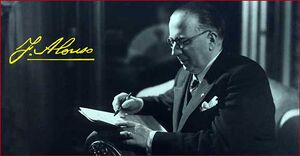

Real name Francisco Alonso López Corral
Life 9 March 1887 – 1948
Occupation
-
• composer
Website: Visit site
Francisco Alonso López (born 9 May 1887 in Granada, died 18 May 1948 in Madrid) was one of Spain's most beloved and prolific composers during the first half of the 20th century. With remarkable versatility and a keen sensitivity to popular taste, he embraced virtually every genre of Spanish musical theatre—zarzuela, revue, sainete, operetta, and musical comedy—crafting melodies that became woven into the cultural fabric of the nation.
Early Life and Musical Education
Francisco Alonso was born in Granada and began his formal education with the Escolapios. Though initially enrolled in medical studies at his father’s urging, he abandoned the path after struggling with anatomy and dissection. His true passion had always been music. He received his first musical instruction from Antonio Segura and later from Celestino Villa, the chapel master of Granada Cathedral.
From a young age, Alonso composed salon music—polkas, mazurkas, waltzes—and even attempted lyrical works, such as La niña de los cantares, premiered in 1905 at Teatro Cervantes. At 16, he conducted the band of the El Fargue gunpowder workers and later formed a choral society within the Granada Philharmonic, performing in city theatres and public squares.
Move to Madrid
The death of his parents (his mother in 1905 and father in 1908) led Alonso to pursue his dream of success in the world of lyrical theatre. On 17 March 1911, armed with 600 pesetas and immense hope, he arrived in Madrid—a city captivated by the cuplé, with stars like La Fornarina and Pastora Imperio dominating the stage. Alonso began composing cuplés with help from fellow Granadan playwright Alfonso Paso.
Early Successes
His first significant theatrical collaboration was ¡Armas al hombro! (1911), composed with Tomás López Torregrosa and premiered at Teatro Martín. In 1913, he partnered with Enrique García Álvarez for El bueno de Guzmán. His breakout came in 1916 with Música, luz y alegría, a revue that earned him widespread acclaim. In 1918, De Madrid al infierno featured the hit chotis “Oye, Nicanora,” marking his ascent as a composer of memorable popular songs.
The Master of the Pasodoble
Alonso’s special talent for pasodobles became clear with Las corsarias (1919), whose patriotic pasodoble “La Banderita” became an anthem. It was sung in cafés and by soldiers en route to the Rif War. King Alfonso XIII even admitted to singing it while shaving.
A Lyrical Portrait of Spain
In the 1920s, Alonso embarked on a project to create a musical mosaic of Spain’s regions:
La linda tapada (1924) – Set in 17th-century Salamanca; includes the popular “Canción del gitano.”
La bejarana (1924) – Also Salamancan; features the widely loved “Pasodoble de los quintos.”
Curro el de Lora (1925) – Andalusian setting; Alonso considered it his finest composition and wished to adapt it into an opera.
La Calesera (1925) – A tribute to Madrid, with the stirring “Pasodoble de los chisperos” and “Himno a la libertad.”
La parranda (1927) – Dedicated to Murcia, containing “Canción del platero” and especially the enduring “Canto a Murcia,” which became the region’s unofficial anthem.
La picarona (1931) – A Segovian story with a passionate “Canto a Segovia.”
Revue and Sainete
Alonso’s versatility extended to light theatre, revues, and comic sainetes:
Las castigadoras (1927) – Featuring the catchy “Chotis de las taquimecas.”
Las cariñosas (1928) – With the hit chotis “La Lola.”
Las Leandras (1931) – His most legendary revue, premiered at Teatro Pavón. Created for Celia Gámez, it included “Pasodoble de los nardos” and the immortal chotis “El Pichi.”
He continued writing revue-style hits into the 1930s with works such as Las de Villadiego, Las de los ojos en blanco (featuring “Horchatera valenciana”), Mujeres de fuego, and the zarzuela Me llaman la presumida.
Later Works and Leadership
After the Spanish Civil War, Alonso transitioned toward operetta and musical comedy:
Doña Mariquita de mi corazón (1942)
Luna de miel en El Cairo (1943)
Aquella noche azul and Tres días para quererte (both 1945)
He remained devoted to zarzuela as well, premiering Manuelita Rosas and La zapaterita in post-war Madrid.
In 1947, Francisco Alonso was elected President of the Spanish Society of Authors and Publishers (SGAE), having previously held other leadership roles within the institution.
Final Years and Death
In his final years, Alonso battled illness, including a detached retina that required surgery and rest. Even during recovery, he remained creatively active, premiering 24 horas mintiendo, a lyrical comedy written by Francisco Ramos de Castro.
Francisco Alonso died on 18 May 1948 at his home on Calle Sagasta in Madrid. His funeral, attended by the Minister of Education and the Mayor of Madrid, drew immense crowds—testimony to the affection the public held for the man whose music so vividly captured the soul of the Spanish people.
Legacy
Francisco Alonso’s music remains emblematic of Spanish musical theatre. His melodies, especially pasodobles and chotis, are still sung and performed across Spain. His remarkable ability to blend regional identity with popular musical forms earned him a place among the greats of 20th-century Iberian music.
Orchestras
No known group memberships.
Recordings
No recordings found.